
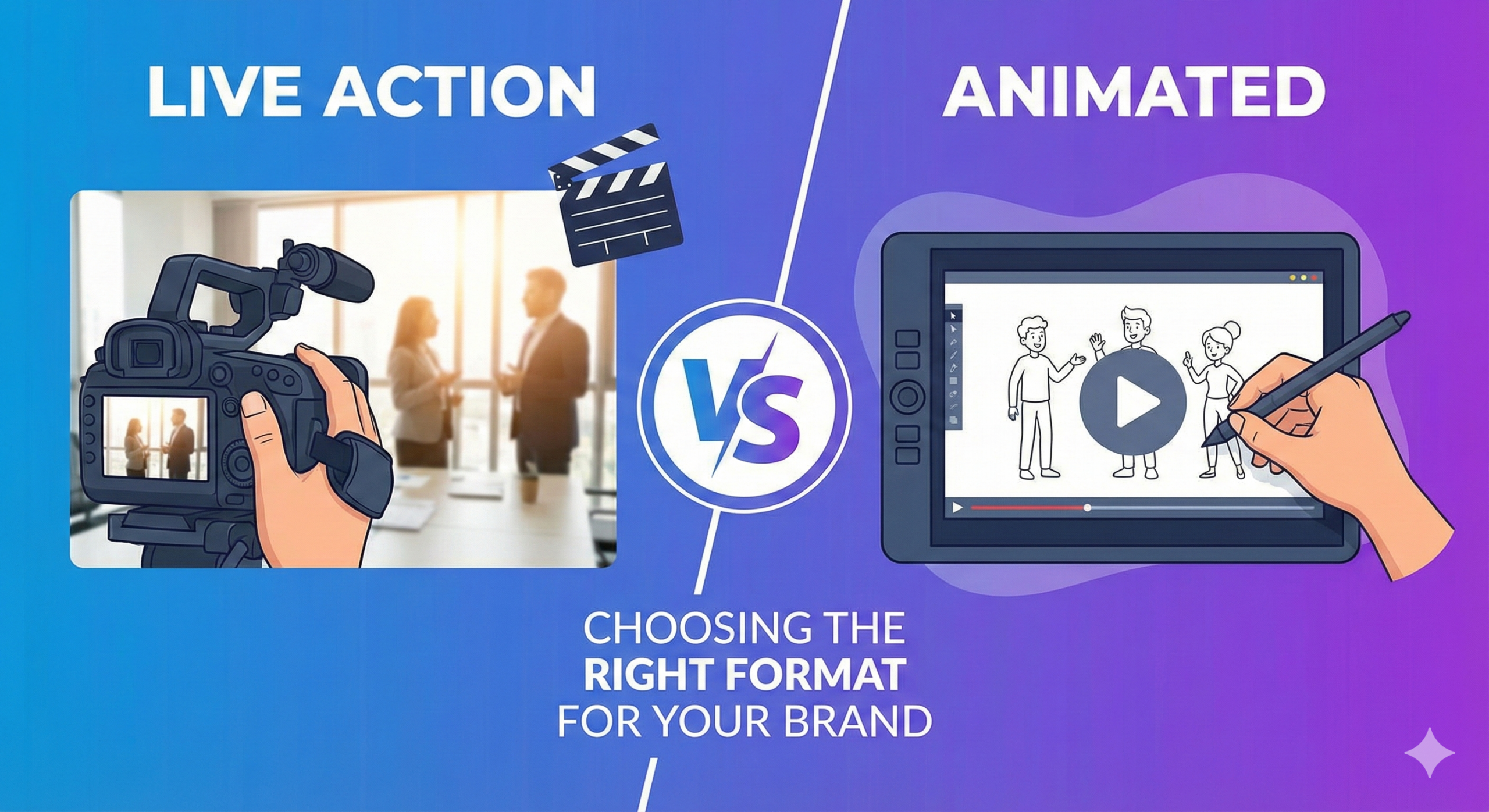

When you’re planning your next video project, the big question often comes down to this: should you go with live action or animation? It’s not just about what looks cooler. The format you choose can make or break how your message lands with your audience.
Both approaches have their place in modern marketing. Live action brings authenticity and human connection, whilst animation offers limitless creativity and flexibility. The trick is knowing which one serves your specific goals better. At Frame Makerzzz, we’ve helped businesses across industries make this decision, and we’ve seen firsthand how the right format can transform a message from forgettable to unforgettable.
Let’s break down what each format brings to the table, so you can make an informed choice for your next video project.
Understanding Live Action Videos
Live action video involves filming real people, real locations, and tangible objects. Think of it as traditional filmmaking. You’re working with actors (or your own team members), physical sets or locations, cameras, lighting equipment, and all the logistics that come with capturing reality.
This format includes everything from corporate testimonials and product demos to behind-the-scenes footage and interview-style content. It’s grounded in the physical world, which immediately gives it a sense of authenticity that’s hard to replicate.
Understanding Animated Videos
Animation creates movement through a sequence of illustrated frames or computer-generated graphics. Unlike live action, everything you see is built from scratch. Characters, environments, objects, every element exists only because an animator brought it to life.
At Frame Makerzzz, we specialise in various animation styles including 2D animation, 3D animation, and explainer videos. Each style serves different purposes, from simplifying complex business processes to creating engaging product demonstrations that capture your audience’s attention.
Advantages of Live Action Videos
Real Human Connection
Nothing beats the power of seeing real faces and genuine emotions. When someone watches a person talk directly to the camera or interact naturally with others, it creates an immediate emotional connection. This authenticity is particularly valuable for testimonials, case studies, or any content where trust and relatability matter.
Faster Production Timeline
Once you’ve done your planning, live action shoots can happen relatively quickly. You might wrap up filming in a few days, depending on your project scope. If you’re working with existing locations and available team members rather than hiring actors and scouting elaborate sets, the process becomes even more efficient.
Flexibility for Last-Minute Changes
During a shoot, you can improvise, adjust dialogue on the spot, or capture unexpected moments that add value to your final video. This real-time flexibility can be a huge advantage when you’re working with subjects who are comfortable on camera.
Showcasing Real Products
If you’re selling a physical product, there’s immense value in showing it exactly as it is. Customers want to see how it looks, how it works, and how real people interact with it. Live action lets you demonstrate functionality in a way that builds immediate trust.
Lower Entry Barrier for Simple Projects
For straightforward videos, you don’t need Hollywood-level equipment. A decent smartphone, good natural lighting, and basic editing software can get you started. This makes live action accessible even for businesses with limited budgets.
Disadvantages of Live Action Videos
Location and Logistics Challenges
Finding the right location, securing permissions, managing weather conditions, these factors can complicate your production. You’re at the mercy of the physical world, which doesn’t always cooperate with your schedule or vision.
Higher Costs for Complex Productions
Once you start hiring professional actors, renting equipment, paying for locations, and assembling a proper crew, costs can climb quickly. A professionally produced live action video can easily run into lakhs of rupees, particularly if you need multiple shooting days or elaborate setups.
Limited Creative Freedom
Physics and reality impose boundaries. You can’t easily show abstract concepts, futuristic scenarios, or impossible situations without expensive CGI, which basically becomes animation anyway. This makes live action less suitable for explaining intangible services or complex technical processes.
Difficult Revisions
Noticed a mistake after the shoot? Want to update product features shown in the video? With live action, you’re looking at reshoots, which means reassembling your team, booking locations again, and essentially starting portions of production over. This can be both time-consuming and expensive.
Environmental Factors
Background noise, changing light conditions, unexpected interruptions, these can derail your shoot. You need controlled environments to maintain consistent quality, which isn’t always feasible.
Advantages of Animated Videos
Unlimited Creative Possibilities
With animation, imagination is your only limit. Want to show how your software works inside a computer? Need to visualise a medical process happening inside the human body? Looking to create a fantastical world that represents your brand values? Animation makes all of this possible without the constraints of physical reality.
Easier to Explain Complex Concepts
Abstract ideas, technical processes, and complicated workflows become much clearer when you can visualise them through animation. At Frame Makerzzz, we’ve created explainer videos for healthcare, technology, and industrial clients precisely because animation simplifies what would be nearly impossible to demonstrate through live action.
No Location or Actor Requirements
You don’t need to book locations, hire actors, or worry about weather conditions. The entire production happens in a digital environment, which gives you control over every element. This also means you can work with animation teams remotely, opening up possibilities for collaboration regardless of geography.
Easy Updates and Modifications
Need to change a logo? Update product features? Revise messaging? With animation, these changes happen in the editing software without needing to reshoot anything. This flexibility is particularly valuable for startups and businesses that frequently update their offerings.
Consistent Brand Identity
Animation lets you maintain a specific visual style across all your content. Once you’ve established your brand’s animation style, you can reuse assets, characters, and design elements across multiple videos, creating a cohesive visual identity.
Better for Long-Term Use
Animated videos age better than live action. Whilst live action videos can look dated due to fashion, technology, or trends, well-designed animation remains visually relevant for much longer.
Disadvantages of Animated Videos
Longer Production Time
Creating animation frame by frame takes time. Depending on complexity, an animated video might take weeks or even months from concept to completion. The process includes scripting, storyboarding, design, animation, voice-over recording, and sound design, each requiring careful attention.
Potentially Higher Initial Investment
Quality animation isn’t cheap. Professional animation services typically cost more upfront than basic live action shoots, particularly for detailed 3D animation or complex motion graphics. However, when you factor in the longevity and update flexibility, animation often proves more cost-effective long-term.
Less Emotional Impact in Certain Contexts
Whilst animation can convey emotion effectively, it sometimes struggles to match the raw authenticity of real human faces and genuine reactions. For testimonials or deeply personal stories, live action might create stronger emotional connections.
Requires Specialised Skills
Unlike live action where you might DIY certain aspects, quality animation demands professional expertise. You’re unlikely to create broadcast-quality animation without experienced animators, which means working with a production company like Frame Makerzzz rather than handling it in-house.
When to Choose Live Action vs Animated Videos
The decision ultimately depends on your specific needs, message, and audience.
Choose live action when:
- You need to establish trust through real testimonials or case studies
- You’re showcasing a physical product that customers need to see in detail
- Your message relies heavily on human emotion and authentic connection
- You have access to compelling locations or visually interesting settings
- Your timeline is tight and you can execute a simple shoot quickly
Choose animation when:
- You’re explaining complex, abstract, or technical concepts
- Your product or service is digital or intangible
- You want maximum flexibility for future updates
- You need to create something impossible to film in reality
- You’re building long-term brand content that needs to remain visually relevant
Combining Both Approaches
Here’s something many businesses don’t consider: you don’t have to choose just one. Some of the most effective videos blend live action with animated elements. You might film real people but add animated graphics to illustrate key points, or create an animated framework that incorporates live action footage.
This hybrid approach gives you the authenticity of live action with the explanatory power of animation. It’s particularly effective for corporate videos, training content, and marketing materials that need to balance professionalism with clarity.
Cost Considerations: Live Action vs Animated Videos
Both formats span a wide cost range depending on quality and complexity.
For animated videos, you might spend anywhere from ₹50,000 for a basic explainer video to several lakhs for elaborate 3D animation or longer content. The investment depends on animation style, video length, complexity, and revision requirements.
Live action costs vary even more dramatically. A simple talking-head video might cost under ₹50,000 if you use minimal equipment and existing locations. However, professional productions with actors, multiple locations, and extensive post-production easily reach several lakhs of rupees.
The key is matching your investment to your needs. At Frame Makerzzz, we help clients navigate these decisions by understanding their goals, audience, and budget constraints before recommending the most effective approach.
Making Your Decision
Start by clarifying your objectives. What action do you want viewers to take after watching your video? Who is your target audience, and what resonates with them? What’s your realistic budget, including potential revisions?
Consider your timeline too. If you need content quickly, live action might win out. If you’re building foundational marketing content that needs to serve you for years, animation’s longevity could justify the longer production time.
Think about your brand identity as well. Does your brand personality lean toward authenticity and relatability, or innovation and creativity? The format you choose should align with how you want customers to perceive your company.
The Frame Makerzzz Approach
At Frame Makerzzz, we don’t push clients toward one format over another. Instead, we listen to your goals, understand your audience, and recommend the approach that will deliver results. Sometimes that’s crisp 2D animation. Other times it’s compelling live action. Often it’s a strategic blend of both.
With over 200 successfully completed projects for clients ranging from startups to established brands like JSW, ICICI Prudential, and Tata, we’ve seen what works across industries. Whether you need an explainer video to simplify your complex offering or a corporate video to build trust with stakeholders, we bring the expertise to make it happen.
The question isn’t whether live action or animation is objectively better. It’s about which format serves your specific message, audience, and goals most effectively. That’s the conversation we’re here to have.
FAQs
Which is more cost-effective for small businesses: live action or animated videos?
For small businesses with limited budgets, animation often proves more cost-effective long-term. Whilst initial costs might seem comparable, animation eliminates expenses like location rentals, actor fees, and equipment. Plus, animated content is easier to update without costly reshoots, making it a better investment if your product or messaging evolves frequently.
How long does it typically take to produce an animated video compared to live action?
Live action shoots can wrap up filming in a few days, though pre-production and editing extend the timeline. Animation typically takes longer, potentially several weeks to months depending on complexity. However, animation provides more predictable timelines since you’re not dealing with weather, location availability, or actor schedules that might cause delays.
Can animated videos create the same emotional connection as live action?
Animation can certainly evoke emotions through storytelling, music, and character design, but it approaches emotion differently than live action. Live action excels at showing genuine human reactions and creating immediate trust through real faces. Animation works better for emotional storytelling that’s imaginative or metaphorical. The best choice depends on the specific emotion you’re trying to convey.
Which format works better for explaining technical or complex products?
Animation typically wins for complex explanations. It allows you to visualise abstract concepts, show internal processes, simplify technical workflows, and use visual metaphors that make complicated ideas accessible. Live action struggles with intangible concepts unless you rely heavily on voice-over explanations, which can lose viewer engagement.
Is it possible to update live action videos if my product changes?
Updating live action requires reshoots, which means reassembling your production team, booking locations again, and incurring significant additional costs. Minor changes like updating on-screen text or graphics are possible in post-production, but anything involving the filmed content itself needs new footage. This limitation makes animation more practical for products that evolve frequently.
