
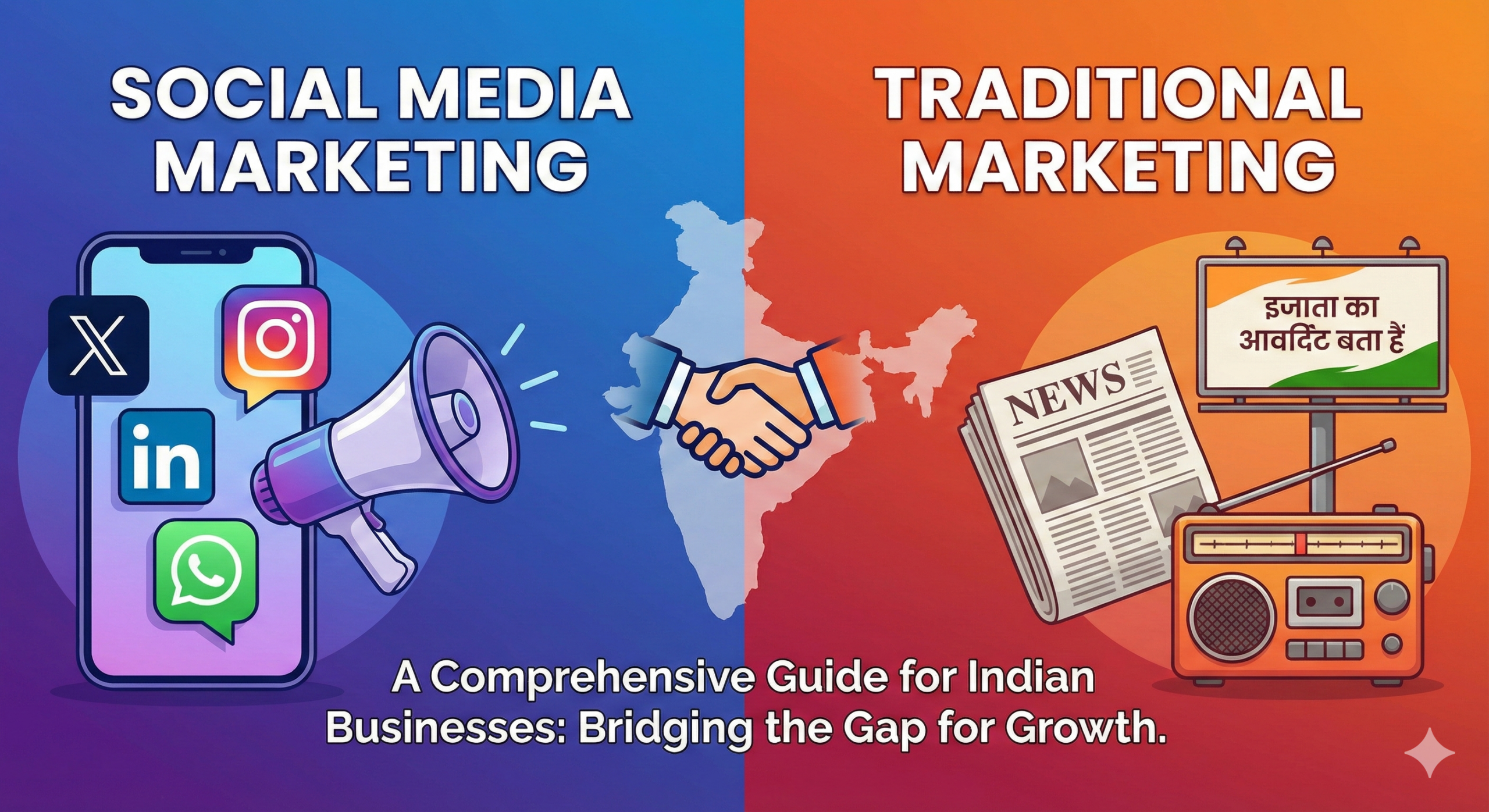

The marketing landscape has undergone a massive transformation in recent years. Where traditional billboards and newspaper adverts once dominated, social media platforms now compete fiercely for consumer attention. For businesses across India, understanding the distinction between social media marketing and traditional marketing has become crucial for developing effective promotional strategies.
Whether you’re running a startup in Mumbai, managing a manufacturing unit in Gujarat, or operating a retail store in Delhi, choosing the right marketing approach can significantly impact your brand’s visibility and growth. This guide explores both marketing methodologies, helping you make informed decisions for your business.
What is Traditional Marketing?
Traditional marketing refers to promotional methods that existed before the digital revolution. These are the conventional approaches businesses have used for decades to reach their target audience through offline channels.
Traditional marketing encompasses print advertisements in newspapers and magazines, television commercials, radio spots, outdoor advertising like hoardings and banners, direct mail campaigns, telemarketing calls, and promotional events or sponsorships. These methods create tangible touchpoints with consumers and have built successful brands for generations.
For instance, companies like Frame Makerzzz often create corporate videos and ad films that can be used in both digital spaces and traditional media channels, such as television, making them versatile marketing assets.
Understanding Social Media Marketing
Social media marketing involves promoting products, services, or brands through social networking platforms such as Facebook, Instagram, LinkedIn, Twitter, and YouTube. This digital-first approach leverages the massive user bases of these platforms to create engagement, build communities, and drive conversions.
The key components include content creation and curation, community management and engagement, paid social advertising campaigns, influencer collaborations, analytics and performance tracking, and user-generated content initiatives. Social media marketing offers unprecedented access to specific audience segments with measurable outcomes.
Social Media Marketing vs Traditional Marketing: Key Differences
Cost and Budget Considerations
Traditional marketing typically requires substantial upfront investment. A full-page newspaper advertisement in a national daily can cost lakhs of rupees, whilst television commercials demand both high production costs and expensive airtime slots. Outdoor hoardings in prime locations require significant rental fees.
In contrast, social media marketing offers more flexible budget options. Businesses can start with minimal investment, running targeted Facebook or Instagram ads for as little as ₹500 per day. This democratisation of marketing allows small businesses and startups to compete with established brands without burning through their entire budget.
Targeting and Reach Capabilities
Traditional marketing follows a broadcast approach, casting a wide net with limited targeting precision. A newspaper advertisement reaches everyone who reads that publication, regardless of whether they’re interested in your product. You might reach thousands of people, but many won’t be part of your ideal customer profile.
Social media platforms provide granular targeting options based on demographics, interests, behaviours, location, and even life events. If you’re selling premium fitness equipment, you can specifically target fitness enthusiasts aged 25-40 in metropolitan cities who follow health and wellness pages. This precision reduces wasted impressions and improves return on investment.
Measurability and Analytics
One of the most significant challenges with traditional marketing is measuring effectiveness. How many people actually saw your hoarding? Did they remember your radio jingle? Traditional methods provide limited metrics, often relying on indirect indicators like increased foot traffic or survey responses.
Social media marketing transforms guesswork into science. Platforms provide detailed analytics showing exactly how many people viewed your content, engaged with it, clicked through to your website, and completed desired actions. You can track cost per impression, engagement rates, conversion metrics, and ROI in real-time, allowing for immediate strategy adjustments.
Engagement and Interaction
Traditional marketing is predominantly one-way communication. Businesses broadcast their message, and consumers passively receive it. There’s limited opportunity for immediate dialogue or feedback, creating a significant gap between brand and audience.
Social media fundamentally changes this dynamic by enabling two-way conversations. Customers can comment on posts, share content, ask questions, and provide feedback instantly. Companies like Frame Makerzzz, which specialise in creating engaging visual content for social platforms, understand how interactive content builds stronger customer relationships and brand loyalty.
Speed and Flexibility
Launching a traditional marketing campaign requires substantial lead time. Creating a television commercial might take weeks or months from concept to broadcast. Once launched, making changes is expensive or impossible. If market conditions shift or your message needs adjustment, you’re locked into your initial approach.
Social media campaigns can be created, launched, and modified within hours. If a particular advertisement isn’t performing well, you can pause it, adjust the messaging or visuals, and relaunch immediately. This agility allows businesses to respond quickly to market trends, competitor actions, or unexpected opportunities.
Longevity and Shelf Life
Traditional marketing materials have finite lifespans. A newspaper advertisement exists for one day, a radio spot plays for a few seconds, and even outdoor hoardings eventually come down. The visibility window is predetermined and limited.
Social media content can have an extended shelf life. A well-crafted post might continue generating engagement months after publication. Evergreen content resurfaces through shares and algorithm recommendations. Additionally, successful campaigns can be repurposed, refreshed, and relaunched with minimal additional investment.
When to Use Social Media Marketing
Social media marketing excels when your target audience actively uses digital platforms, which is increasingly true across India’s urban and semi-urban markets. It’s particularly effective for e-commerce businesses needing direct purchase pathways, brands targeting younger demographics who spend significant time online, and businesses seeking to build engaged communities around their products.
Companies offering innovative or niche products benefit from social media’s ability to reach specific interest groups. Businesses with limited marketing budgets can achieve significant reach without substantial investment. If you’re launching new products and need rapid market feedback, social media provides immediate consumer insights.
For businesses like Frame Makerzzz that create explainer videos and animated content, social media platforms offer ideal venues for showcasing work, engaging potential clients, and demonstrating creative capabilities through visually compelling posts.
When Traditional Marketing Still Matters
Despite digital’s dominance, traditional marketing remains valuable in specific contexts. When targeting older demographics less active on social media, traditional channels often prove more effective. Local businesses aiming to reach nearby customers might find local newspapers or radio stations more relevant than broad social media campaigns.
Certain industries like luxury goods and pharmaceuticals benefit from traditional media’s perceived credibility and prestige. Television commercials and print advertisements in respected publications lend authority that social media posts sometimes lack. For major product launches or brand-building exercises, traditional media’s broad reach creates mass awareness efficiently.
Events, sponsorships, and physical promotional activities create memorable brand experiences that digital campaigns struggle to replicate. Traditional marketing also reaches consumers in specific physical contexts where digital isn’t accessible.
Creating an Integrated Marketing Strategy
The most effective approach often combines both methodologies. Rather than choosing between social media marketing and traditional marketing, progressive businesses integrate them strategically.
Create synergies by using traditional media to drive social media engagement. Include social media handles and hashtags on print advertisements, television commercials, and outdoor hoardings. Conversely, use social media to amplify traditional campaigns, encouraging followers to watch your television commercial or visit your physical store.
Develop consistent messaging across all channels whilst adapting format and tone to suit each medium. What works as a 30-second television spot might need reimagining as a carousel post on Instagram. Allocate budget based on where your audience spends time and which channels deliver the best returns for your specific objectives.
The Indian Marketing Context
India’s unique market dynamics require special consideration. With over 700 million internet users but diverse digital literacy levels, marketing strategies must account for both connected urban consumers and traditional rural markets.
Regional languages matter significantly. Whilst English and Hindi dominate in some spaces, content in Tamil, Telugu, Bengali, Marathi, and other regional languages often resonates more deeply with local audiences. Both social media and traditional marketing should reflect this linguistic diversity.
Mobile-first consumption patterns shape how Indians consume content. Social media strategies must prioritise mobile-optimised experiences, whilst traditional marketing should acknowledge that many consumers simultaneously engage with multiple screens.
Measuring Success in Both Approaches
Success metrics differ substantially between methodologies. Traditional marketing often measures reach through circulation numbers, viewership ratings, and estimated impressions. Success indicators might include increased brand awareness, foot traffic, or phone enquiries.
Social media provides more granular metrics, including engagement rate, click-through rate, conversion rate, cost per acquisition, follower growth, share of voice, and sentiment analysis. Combine quantitative data with qualitative feedback to gain a comprehensive performance understanding.
Future Trends and Considerations
The marketing landscape continues evolving rapidly. Video content grows increasingly dominant across channels, with short-form videos on platforms like Instagram Reels and YouTube Shorts capturing attention effectively. Companies specialising in video production, including animation studios and corporate video makers, find growing demand for diverse video content.
Artificial intelligence and machine learning enable more sophisticated targeting and personalisation in digital marketing. Meanwhile, privacy regulations and cookie deprecation are reshaping how marketers collect and use consumer data, requiring more creative targeting approaches.
Traditional media itself is evolving, incorporating digital elements through QR codes, augmented reality experiences, and smart billboards. The boundary between traditional and digital marketing becomes increasingly blurred.
Making Your Decision
Choosing between social media marketing and traditional marketing ultimately depends on your specific business context. Consider your target audience demographics and media consumption habits, marketing budget and resource availability, business objectives and success metrics, product or service characteristics, competitive landscape, and geographic market scope.
For many businesses, the answer isn’t choosing one over the other but finding the right balance. Start by understanding where your customers spend their time and attention. Invest in channels that provide the best return whilst remaining open to testing new approaches.
Frequently Asked Questions
Q1: Which is more cost-effective for small businesses: social media marketing or traditional marketing?
Social media marketing typically offers better cost-effectiveness for small businesses with limited budgets. You can start campaigns with minimal investment, often just a few hundred rupees daily, and scale spending based on results. Traditional marketing usually requires higher upfront costs for television spots, newspaper advertisements, or outdoor hoardings, making it less accessible for businesses with tight budgets. However, cost-effectiveness ultimately depends on your target audience and business goals.
Q2: Can traditional marketing and social media marketing work together effectively?
Absolutely! The most successful marketing strategies integrate both approaches. Use traditional media like television or print to build broad brand awareness, then direct audiences to social media platforms for deeper engagement. Include social media handles and campaign hashtags on traditional advertisements. Similarly, use social media to amplify traditional campaigns, creating buzz around television commercials or outdoor advertisements. This integrated approach maximises reach whilst building engaged communities.
Q3: How do I measure ROI for social media marketing compared to traditional marketing?
Social media marketing provides detailed, real-time analytics including impressions, engagement rates, click-through rates, conversions, and cost per acquisition. Most platforms offer built-in analytics dashboards showing exactly how your investment translates into results. Traditional marketing measurement is less precise, relying on indirect indicators like increased sales during campaign periods, customer surveys, or estimated reach based on circulation or viewership data. Social media’s measurability makes ROI calculation more straightforward and accurate.
Q4: Is traditional marketing becoming obsolete with the rise of digital platforms?
Traditional marketing isn’t obsolete, but its role is evolving. Whilst digital channels dominate many sectors, traditional media remains effective for reaching certain demographics, particularly older audiences and rural markets with limited internet access. Television, radio, and print still command significant audiences in India. However, businesses must recognise that younger consumers increasingly favour digital channels. The key is understanding your specific audience and choosing channels where they’re most receptive.
Q5: What skills are needed to manage social media marketing effectively?
Effective social media marketing requires content creation abilities, including copywriting and visual design skills, understanding of platform algorithms and best practices, community management and customer service skills, analytical capabilities to interpret performance data, paid advertising knowledge, including targeting and budget optimisation, staying current with trends and platform updates, and basic graphic design or video editing skills. Many businesses partner with agencies or specialists for services like animated content creation, explainer videos, or comprehensive social media management to ensure professional execution.

